An unread direct message isn’t just a missed notification. It’s a high-intent buyer whose interest is actively dying down by the minute. If a prospect replies to your Instagram Story or sends a WhatsApp inquiry, they expect you to resolve it as soon as possible. When that user is stuck in a queue for hours while a human social media manager works to clear a swollen inbox, they will just go and buy from your competitor. We call this the manual messaging tax, and it quietly destroys your customer acquisition costs (CAC).
You cannot hire your way out of this structural problem. Throwing more human agents at a shared inbox inevitably creates collision errors. Two reps attempt to answer the same ticket, Meta rate-limits your account for aggressive manual typing bursts, and your team still struggles to process a basic order lookup without constantly switching browser tabs between the inbox and your Shopify dashboard. Human hands simply break under the weight of high-volume conversational commerce.
The fix happens at the infrastructure level. Transitioning from reactive, manual inbox checking to proactive bot automations changes the fundamental math of your sales pipeline. By deploying specialized automated bot software, you wire your social profiles directly into your backend databases. This guide breaks down the exact technical architecture required to build a machine that qualifies leads, recovers abandoned carts, and syncs data to your CRM, all without a human touching the keyboard.
Expert Insight: Lessons from the Webhook Trenches
Author: Mahad Asghar, Lead Systems Architect
“When I audit a brand’s messaging setup, the failure point is almost never the front-end chat interface. It happens in the backend. I watch systems collapse because they try to process heavy database queries directly on the incoming webhook thread, causing Meta to timeout the connection. Building real conversational infrastructure means treating DMs like API calls. You need message queues, asynchronous processing, and strict token management to survive a traffic spike.”
The Advanced Quick Win: Headless Cart Recovery Routing
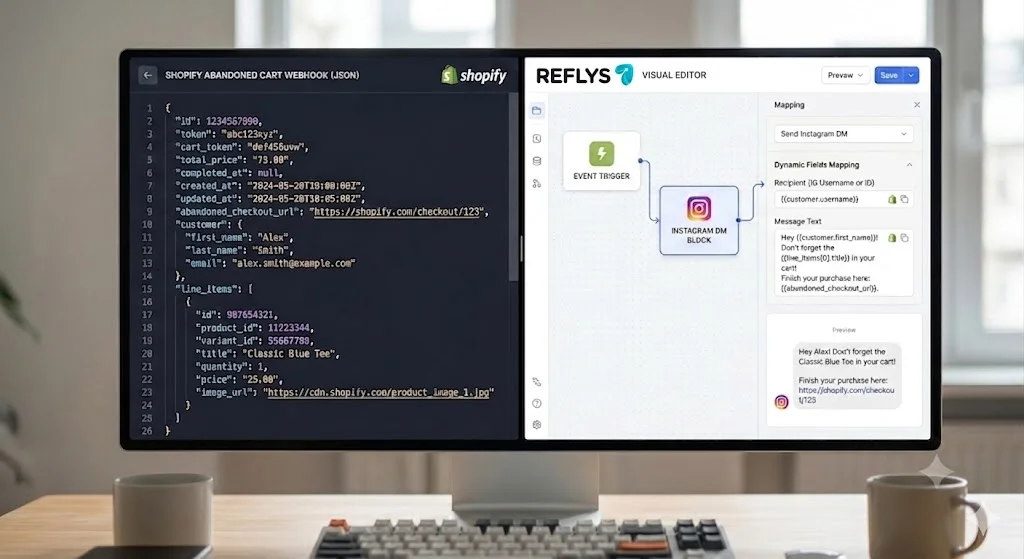
Before we look at the broader system architecture, let us deploy an immediate tactical flow. Most brands send an email when a user abandons a cart. A fraction of users open those emails. Instead, we are going to build a programmatic webhook loop that pushes a checkout recovery link directly to the user’s Instagram or WhatsApp DM the moment their session times out.
The idea is to be able to connect your event triggers directly from your eCommerce platform to your messaging middleware.
Step-by-Step Execution
- The Event Listener: On the Event Listener side, the Event Listener will configure an outbound web hook (HTTP post) on your e-commerce backend (Shopify, WooCommerce, Node.js stack). Fire this when exactly a check out session is marked as abandoned – in this case, 30 minutes after that time.
- Payload Serialization: Make sure that the outgoing JSON payload includes the user variables that are necessary. You must have the checkout_url, cart_total and custom social_opt_in_id that you captured on the first site visit.
- Conditional Execution: The system checks a user’s interaction history. Have they sent us anything in the past 24 hours? If it is, it sends a custom text node to the Meta API that includes a link to the active checkout. If the window is closed, it gracefully drops the request or falls back to the SMS node.
The Mechanics of Meta API Orchestration
To develop messaging channels capable of serving millions of users concurrently, it’s important to understand the way that Meta’s Graph API behaves in reality. Drag-and-drop interfaces can be beneficial if you do not want to dive deep into the intricacies; however your system’s performance is contingent on what you do with tokens as well as limit rates.
Navigating the Token Lifecycle
You need an authentication token for each call you make to send a message. These are highly pricey tokens that are prone to volatility.
A Facebook Page Access Token or Instagram Professional account access token is created when you link a Facebook Page or Instagram Professional account to your software. This token is associated with the specific admin user who enabled the connection. The Page Access Token will automatically expire if that admin changes their Facebook password, if they undergo a security check, or if they are removed from the Page roles.
When this happens, all messages your system attempts to send will throw an OAuth exception. To avoid this, your architecture needs an automatic ping to the debug_token endpoint. If a token fails, the system must pause the outbound message queue and immediately fire a critical alert in your engineering team’s Slack channel so it can be re-authorized manually.
Webhook Ingestion and the 2000ms Rule
When a user DM’s you a keyword, the server receives a webhook with all the information about the message. Meta has a “hard and fast” rule: Your server must respond with an HTTP 200 OK within 2000 milliseconds after receiving the webhook.
If there’s a server delay, but no server, then Meta assumes that your application has crashed. This will happen again and again, and it will cause your webhook delivery to be slowed down, essentially disabling your bot.
This timeout usually happens because developers try to process the user’s message, query a database, and formulate a reply all within the initial webhook connection. This is a fatal architectural flaw.
Ingestion vs. Processing Architecture
| Architecture Type | How It Handles Inbound Messages | Risk of Meta Timeout | Ideal Use Case |
|---|---|---|---|
| Direct Synchronous | Receives webhook, queries CRM, generates response, sends reply, then closes connection. | Extremely High (>50% during spikes) | Low-volume testing environments only. |
| Asynchronous Message Queue | Receives webhook, saves raw payload to Redis, immediately closes connection (returns 200 OK). Worker nodes handle the rest later. | Near Zero | Production-grade automated bot software handling high traffic. |
| Serverless Functions | Receives webhook via AWS Lambda, spins up instance to process logic. | Medium (Cold start delays can exceed 2000ms) | Sporadic traffic patterns. |
You must decouple ingestion from logic. Put a Redis or RabbitMQ queue in front of your core application. Catch the webhook, dump it in the queue, and tell Meta “Got it.” Then, let your background workers process the queue at their own pace.
State Management and Intent Classification
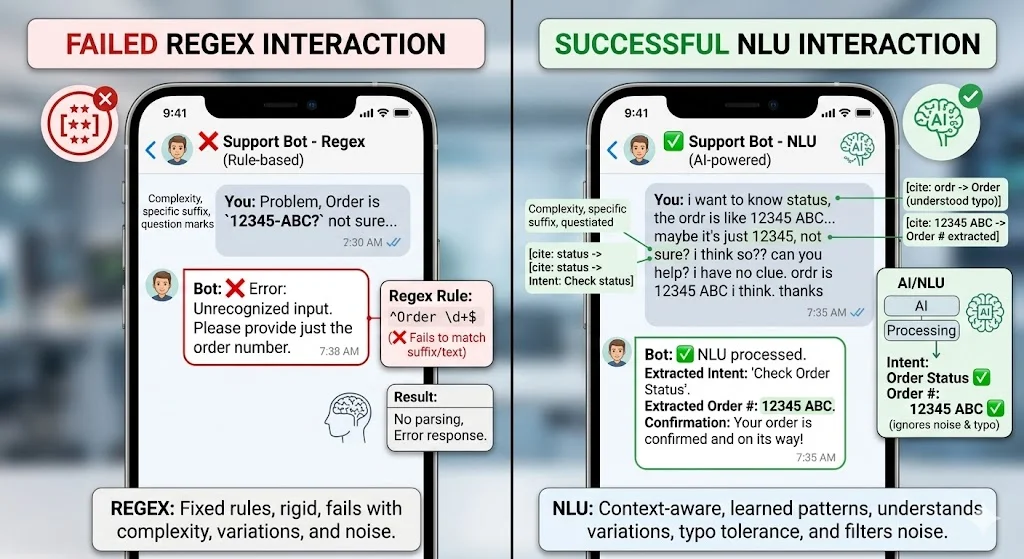
The initial chatbots were unsuccessful due to their use of the fixed keywords matching. When a user types in the string “How do I send this back?,” the system drops the second rule, when the user types “RETURN”, and executes the return policy.
Moving Past Regular Expressions
Regular Expressions (Regex) force the user to guess the exact command your system wants. This creates massive friction. Instead, modern platforms use Natural Language Understanding (NLU) layers to parse the sentence into actionable data components.
When a user types “I need to change the shipping address on order #99482,” the NLU engine breaks this down:
- Intent: update_shipping
- Entity 1 (Order ID): 99482
The system ignores the filler words. It isolates the intent, grabs the specific order number, and passes those variables via an API call directly to your fulfillment software to hold the shipment.
Contextual Memory in the Thread
A user rarely performs a lengthy operation in just one interaction. They may request the blue one, wait 3 minutes, then say, “Make it red.”
Your system will not have context and it will ask the user to repeat if it treats each webhook as a separate event. You need to maintain a state session in your database. Every interaction updates the user’s temporary profile. Once the user hits a specific milestone like confirming the final color and size, the system bundles those state variables and fires the final checkout generation API call.
The Handover Protocol: When Human Intervention is Required
Even the best logic trees hit dead ends. A user might have a highly specific technical issue, or they might simply be frustrated. When sentiment analysis flags an angry user, the system must execute an immediate state break.
Meta provides a specific mechanism for this called the Handover Protocol. When you set up your architecture, you assign your bot automations as the Primary Receiver. You assign your human live-chat desk (like Zendesk, Intercom, or the Reflys team inbox) as the Secondary Receiver.
When the user requests a human, your system fires a pass_thread_control API request to Meta.
- Meta instantly blocks the automated bot software from sending further automated replies.
- The thread is pushed to your Secondary Receiver.
- A human agent takes over the conversation.
- When the problem is fixed, the human agent clicks a button, sending a take_thread_control request to the automation engine.
This way, your automation rules don’t push your sales reps out of the way as they chase high-dollar sales.
CRM Harmonization: Destroying the Data Silo
Social media managers tend to view DMs as a distinct realm from the company’s other information. But if someone takes 10 minutes in a LinkedIn or Instagram direct message to respond to qualifying questions but then the data gets stuck in a chat log, it’s not useful.
Two-Way Dynamic Syncing
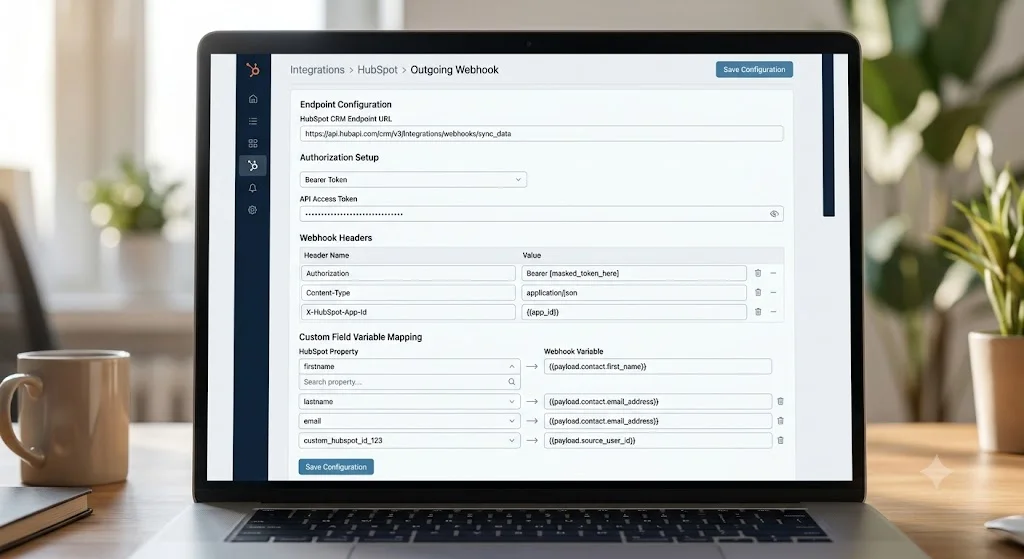
Each time your flow retrieves a piece of valuable information, make sure there is an outbound REST API call.
Let’s assume you are using HubSpot. The question for your flow is “What is your monthly ad spend?”. The user clicks on a quick-reply button labeled “$10k – $50k”.
Your system, instantly, obtains the social ID from the user, determines whether there is a contact record in HubSpot for this ID, and sends a PATCH request to update the monthly_ad_spend property of that contact.
When your sales team logs in to HubSpot the following morning, they find that their lead profile has been fully enriched with budget information, waiting in their sales pipeline.
Industry Execution: B2B vs. Retail Pipelines
The architecture remains the same, but the payload strategies differ entirely based on your business model.
High-Ticket B2B Validation
For SaaS companies and agencies, the goal is disqualifying bad leads before they take up space on a calendar.
API Troubleshooting Matrix
Integrations break. Knowing how to diagnose the error codes from Meta and your external APIs is what keeps your pipelines running.
| Error Code / Exception | Technical Root Cause | Automated Remediation Strategy |
|---|---|---|
| Meta Graph Error 100 | Page Access Token Invalidated (Password change or permission revoked). | Pause all outbound queue workers. Trigger PagerDuty/Slack alert for admin OAuth refresh. |
| HTTP 504 Gateway Timeout | Application took longer than 2000ms to return a 200 OK to Meta. | Audit database query latency. Ensure Redis queue is successfully decoupling ingestion. |
| Meta Graph Error 2018001 | Attempted to send a standard message outside the 24-hour interaction window. | Catch the exception in the code; route the payload to an SMS API or drop the request. |
| CRM REST API 429 | Hit the rate limit for external CRM updates (e.g., too many HubSpot writes). | Implement exponential backoff in your worker nodes. Delay the POST request by 5 seconds and retry. |
The 24-Hour Policy and Operational Compliance
You cannot treat social DMs like an email blast list. Meta enforces strict usage policies to prevent brands from spamming users. If you violate these, they will permanently restrict your API access.
The 24-Hour Window
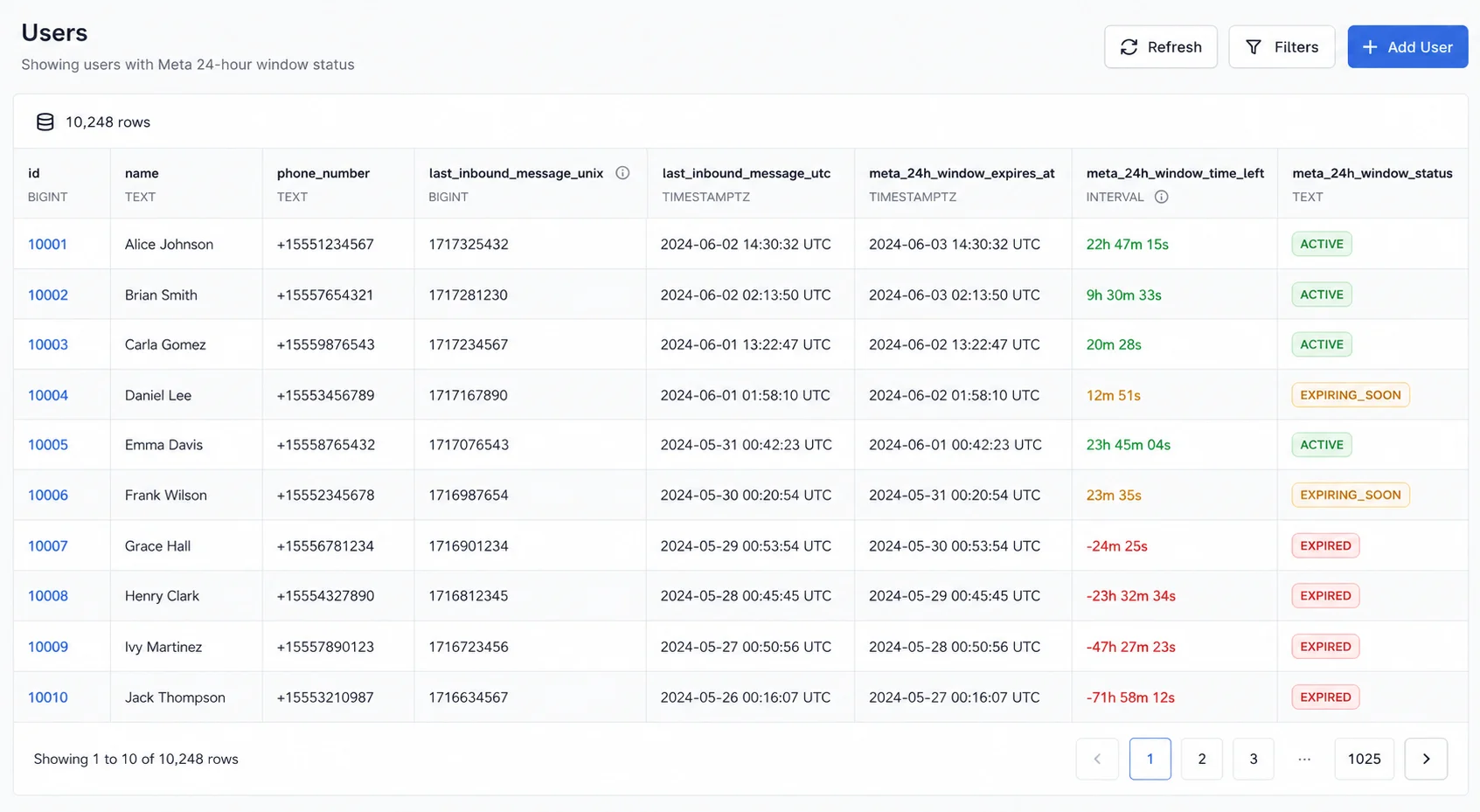
Every time someone sends you a message to your page or Instagram account, there’s a window that opens up for 24 hours. In this timeframe, you can send your automated bot software promotional messages, follow-ups and free-form text.
The window closes after 24 hours of an inbound message. After hour 25, if you attempt to push a normal message using the API, Meta will reject the message and throw an error.
If the user is outside this window, you need to use very specific Message Tags (e.g. when you send them a shipping update) or a WhatsApp Message Template, which is a pre-approved template, and incurs delivery costs per message. Your database architecture must log the exact UNIX timestamp of every inbound user interaction to calculate this window dynamically before attempting an outbound API call.
Re-Engineering Your Revenue Infrastructure
Managing inbound social traffic through manual human effort is a guaranteed way to bleed revenue. Every minute a prospect waits for a reply, your customer acquisition cost increases. Scaling conversational commerce requires treating your messaging channels like serious technical infrastructure, built on reliable APIs, asynchronous processing, and deep database integrations.
By implementing context-aware bot automations, you remove the human bottleneck entirely. Qualify enterprise leads in real-time, recover abandoned checkouts programmatically, and have all data collected in a DM sync completely to your CRM.
Don’t let old school manual processes hold you back. It’s time for your tech stack to get upgraded. Switch to Reflys to create more resilient conversational infrastructure and schedule a technical demo today and discover for yourself how our routing systems can handle the scale your team cannot.