You launch a campaign. The algorithm picks it up, and suddenly, your Instagram inbox is drowning. Hundreds of people want sizing details, shipping times, or a specific product link right now. If your team takes forty minutes to reply, those buyers are already gone. This exact scenario is why an AI chatbot platform for business transitions from a nice-to-have software tool into critical infrastructure.
Trying to manage omnichannel traffic through native mobile apps simply breaks down at scale. Social media managers cannot physically bounce between TikTok, WhatsApp, and Facebook Messenger, cross-check a Shopify dashboard for order statuses, and type custom replies fast enough. The math works entirely against you. Manual routing kills impulse purchases, drives up your cost per acquisition (CPA), and burns out your support staff.
The fix requires pulling the human out of the initial contact layer. When you connect zero-code intelligent agents directly to your social endpoints and native CRMs, you stop managing messages and start orchestrating conversions. You capture the lead, fulfill the request, and close the sale inside the DM.
Expert Insight: After building conversational commerce funnels for high-growth direct-to-consumer brands, I learned a hard truth. Forcing users to click a “link in bio” to find a product destroys conversion rates. The real financial return hits when you use a visual, zero-code builder to process the sale directly inside Instagram or WhatsApp. Once the bot can read a comment, instantly trigger a DM, capture an email, and push that lead natively into HubSpot, your operational overhead drops significantly.
Advanced Quick Win: The 23-Hour Conditional Follow-Up Loop
Do not settle for a basic “Thanks for messaging us” auto-reply. Build a conditional routing workflow tied directly to Meta’s strict 24-hour messaging window to recover abandoned interest.
Set up a visual flow triggered by a specific keyword in an Instagram Reel comment, such as “VIP.” When the user comments, the system instantly sends a private DM delivering a discount code. Add a conditional logic delay right after that step. Tell the system to wait exactly 23 hours. It then checks if the user clicked the link or handed over their email. If they did not, the platform automatically fires a highly personalized follow-up message just before the Meta API window closes. You push the conversion one last time, maximizing your lead capture rate before a human ever touches the keyboard.
Core Capabilities of an AI Chatbot Platform for Business
The majority of the decision makers mix up simple FAQ widgets with strong conversational systems. The right omnichannel setup acts as the hub for orchestration. It understands what a user wants, follows platform compliance rules, and sends zero-party data to your marketing stack without writing a single line of API code.
Intent Recognition Without the Code
Old-school bots keep on coming up short as they are based on fixed and exact keyword matching. When a user types in “Where is my package?” rather than the exact wording “Order Status,” the flow is broken and the customer is frustrated. Advanced architectures overcome this by using pre-trained machine learning models to capture intent from noisy and misspelled human input.
Suppose a customer wants to return the red shirt they purchased the previous Tuesday and asks to exchange it for a blue medium. Suppose a customer types in WhatsApp, “I would like to return the red shirt that I bought the day before yesterday. Can I trade it for a blue medium? ” A robust zero-code system identifies the core action (exchange), grabs the specific variables (red shirt to blue medium), and parses the timeline (last Tuesday). It holds this data state. It does not ask the user to repeat themselves; it simply fetches the return policy logic and executes the authorization natively inside the chat interface.
The Unified Omnichannel Inbox
Conversations mean nothing if your team has to hunt across five different apps to find them. The defining line between a frustrating software tool and a true business asset is unified state management.
Instead of passing a user a link to a contact form when an automated flow reaches its limit, your automation layer routes the exact conversation history into a centralized dashboard. Whether the customer messaged your brand on TikTok, WhatsApp, or Instagram, your human team sees a single, unified thread.
Feature Architecture: Native App Management vs. Zero-Code Automation Platforms
| Management Strategy | Native Social Media Apps | Zero-Code AI Platforms |
|---|---|---|
| Response Protocol | Manual typing or basic static quick-replies. | Dynamic intent mapping and visual flow logic. |
| Backend Connectivity | Isolated. Requires manual copy-pasting to a CRM. | Native integrations with Shopify, Salesforce, Mailchimp. |
| Lead Capture | Manual data entry from reading individual DMs. | Automated variable extraction (email, phone) in-chat. |
| Multi-Channel View | Requires logging into multiple separate applications. | Centralized unified inbox for all platform DMs. |
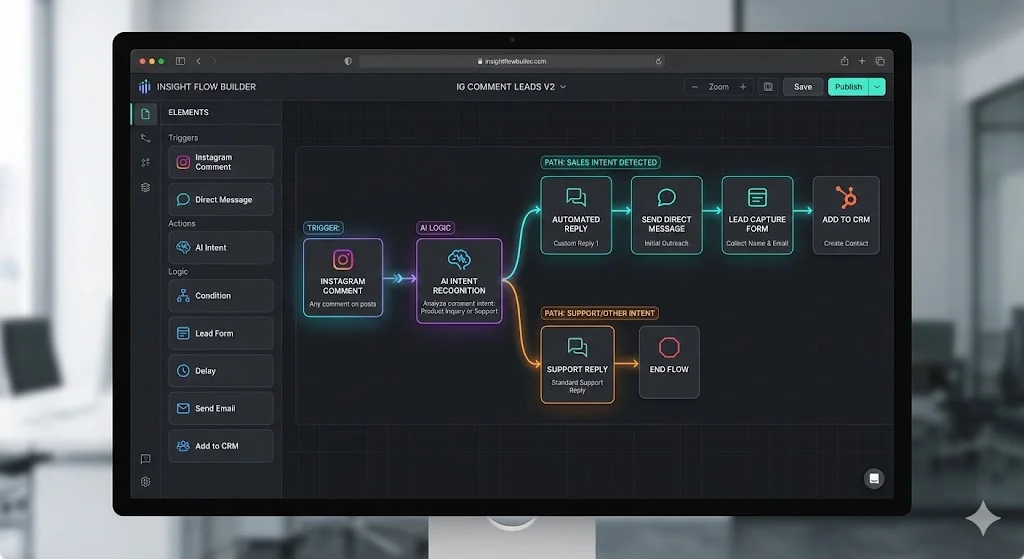
Designing Business Chat Automation Architectures
You are deploying a digital sales force. You cannot just connect your Instagram account, walk away, and expect it to print money. Building the architecture requires tight control over platform compliance, fallback protocols, and CRM synchronization.
Navigating Meta API Compliance Rules
Social media networks fiercely defend their user experience. Spam is not received at apps like WhatsApp and Instagram; they have a strict rule where messages are only allowed during a 24-hour period. A business can only respond to a message or a promotional one for 24 hours when a user messages a business. After that time, the business cannot send any promotional messages until the user starts a new conversation. Not only are your messaging features not just halted, they are now limited. Other than these (pre-approved) tags, it is not possible to send any other message to the user outside this window on Messenger or on WhatsApp using paid, pre-approved template messages.
This architecture must be taken into account in the design of your automation. These restrictions are automatically handled by premium platforms, so you won’t accidentally break Meta’s rules and forfeit access to the API. If the automated flow needs to be followed up with a promotion, the system ensures it is carried out within the compliance window. If you’re engaged for after 24 hours, the software automatically activates the relevant tags or approved templates, ensuring your operations remain compliant.
Native E-commerce and CRM Integrations
Users hate leaving their preferred app. If a buyer has to go to your site to see if you’re still carrying a product, it creates friction and it results in a loss of sale.
The platforms take care of this with native and plug-and-play integrations. When a user asks about an order, the system queries Shopify directly, pulls the tracking status, and displays it inside the WhatsApp chat. When a user provides their email in an Instagram DM to get a coupon, the system pushes that exact contact into Mailchimp instantly. This triggers your external email drip campaigns without requiring a single Zapier task.
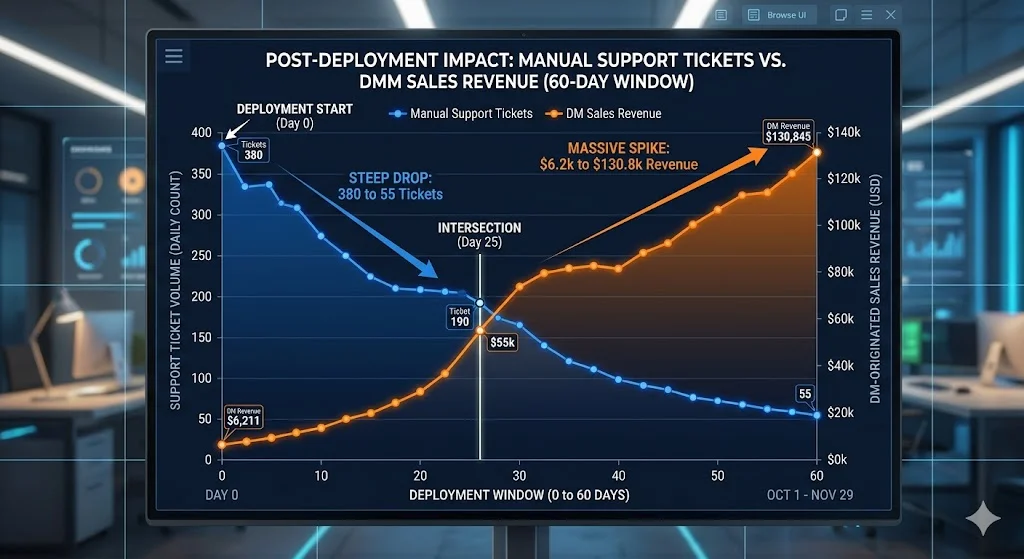
Quantifying the ROI: Metrics That Matter for Social Selling
You have to defend the software spend to your stakeholders. Moving to automated social chat requires tracking hard operational metrics that prove the system is actually generating revenue and cutting overhead, not just acting as a fancy answering machine.
Measuring Lead Capture and True Deflection
Forget tracking “total messages sent.” That metric is pure vanity. Monitor the Lead Capture Rate: the precise proportion of anonymous social media followers that enter a DM flow and are ready to provide their e-mail handle or cell number.
Industry benchmarks for direct-to-consumer brands reveal that 35% to 50% of their DM leads typically converge into leads, with a majority of those leads being converted into customers.A strong direct-to-consumer brand performs a 35% to 50% conversion rate on DM lead capture workflows, with many of those leads being converted to customers. This reduces cost-per-acquisition right away. For the customer support tickets, track True Deflection. When the bot successfully verifies an order number, provides a tracking link, and closes the conversation without human intervention, your average handling time plummets. Your staff stops copying and pasting tracking numbers and starts handling complex, high-value sales questions.
Financial Impact of Automated Social Commerce Routing
| Operational KPI | Manual Human Baseline | Post-Automation Implementation | Primary Technical Driver |
|---|---|---|---|
| Initial Response Time | 45 – 90 minutes | < 2 seconds | Instantaneous visual flow triggers upon comment/DM. |
| DM Lead Conversion | 2% – 5% | 35% – 50% | Frictionless in-chat data collection without web forms. |
| Cart Recovery Rate | Low (via email only) | High (via WhatsApp/SMS) | Direct mobile push notifications with 90%+ open rates. |
Deploying Secure and Compliant Lead Capture Systems
The importance of data governance is not diminished by informal settings, like social media. When data is handed over to social media, you have the complete onus of responsibility regarding the mechanisms of data storage, processing, and data flow.
Opt-Ins and Data Privacy
European customers are protected by the GDPR and Californian customers by the CCPA. This means your chat structure must provide explicit opt-in nodes in the flow itself. The flow should clearly include the opt-in message, which is legally required, when asking for a phone number in order to send SMS updates on Facebook Messenger or WhatsApp.
These compliance nodes can be dragged and dropped into the builder on premium platforms. If the user says no to opt-in, the system will automatically redirect to a secure web link for the user to browse anonymously, instead of keeping the data in the chat log. This helps you maintain your brand legality and user preference.
Seamless Handoffs: Bridging AI and Human Workforces
Automation breaks down entirely when the handoff fails. The exact second the AI reaches the limit of its programmed flow, the transition to your human team must be invisible to the end user.
Modern architectures feed the escalation directly into the unified inbox. Before the human reads the first message, the system classifies the chat with intent as either “High-Value Lead” or “Urgent Support”. The agent can see the exact route the bot followed, the data it has already gathered and the exact question the user asked. The human simply takes over the chat thread directly from their dashboard without asking the customer to repeat a single detail.
Troubleshooting Matrix for Social Chat Automation
| System Failure Mode | Diagnostic Check | Required Fix |
|---|---|---|
| Flow Stops Sending Messages | Check Meta 24-hour compliance window logs. | Adjust follow-up timers to execute strictly within 23 hours of the last user interaction. |
| Intent Misclassification | Audit the AI confidence threshold for incoming queries. | Add more specific training phrases or fallback keywords in the visual builder settings. |
| CRM Fails to Sync Leads | Verify native integration authorization tokens. | Re-authenticate the HubSpot, Mailchimp, or Shopify connection within the platform integrations tab. |
Best Practices for Scaling Your Architecture
Launch small and scale aggressively. Do not attempt to automate every single social media interaction on day one. You will overwhelm your team and likely build flows that frustrate your customers.
Start by analyzing your historical comment data. Find the highest-volume repetitive action. Usually, this is people asking for a link to a product featured in a recent video. Build a single, tight “Comment-to-DM” flow specifically for your next Instagram Reel. Watch the analytics daily. Track exactly where users drop off in the conversation.
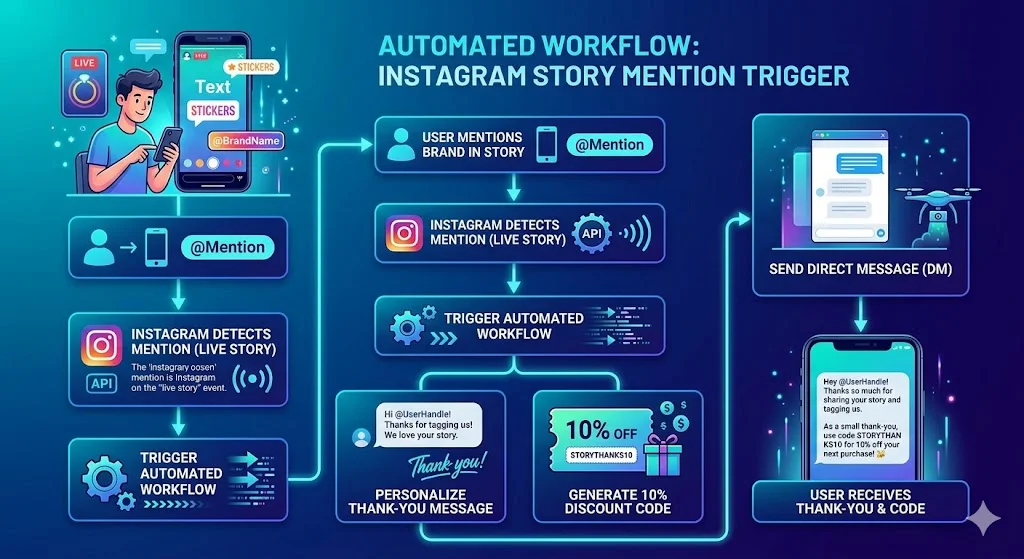
Once that single workflow hits a high conversion rate, expand your territory. Move into Instagram Story mention triggers, complex WhatsApp cart recovery flows, or automated lead qualification questionnaires for high-ticket B2B services. Build the infrastructure block by block, verifying the data capture at each step.